
Civil judgment terminology explained: A practical 2026 guide
Master civil judgment terminology to make informed decisions about collection or sale. Learn enforcement methods, liens, garnishment, and strategic options for 2026.
Great Lakes Strategic Capital
Great Lakes Strategic Capital

Many people believe a civil judgment simply marks the end of a lawsuit. In reality, a civil judgment is a legally enforceable court order that can compel payment, transfer property, or mandate compliance. Understanding the terminology surrounding judgments empowers you to make informed decisions about collection or sale. This guide breaks down essential terms, enforcement tools, and strategic considerations to help you navigate the judgment process effectively.
Table of Contents
- What Is a Civil Judgment? Key Definitions and Elements
- Enforcement Methods and Legal Tools Explained
- Navigating Judgment Liens, Collections, and Selling Judgments
- State-Specific Considerations and Practical Tips for Judgment Enforcement
- Explore Solutions for Judgment Collection and Sales
- Frequently Asked Questions
Key Takeaways
| Point | Details |
|---|---|
| Enforceable Orders | Civil judgments are court orders with multiple enforcement methods, including garnishment, liens, and levies. |
| Final vs. Interlocutory | Understanding whether a judgment is final impacts your appeal rights and enforcement timeline. |
| Collection Strategies | Enforcement must align with the debtor's assets, state laws, and available legal tools. |
| Judgment Liens | These arise from court rulings and differ from property liens in origin and enforcement. |
| Selling Judgments | Transferring collection rights to third parties provides upfront cash for uncollected awards. |
What Is a Civil Judgment? Key Definitions and Elements
A civil judgment represents more than a legal victory. It is a legally enforceable court order that may require the payment of monetary damages, the transfer of property, or compliance with specific directives. The judgment becomes your legal foundation for recovery.
Valid civil judgments require specific elements: clerk entry into court records, a final determination of the parties' rights, proper service and notice to all involved parties, and valid jurisdiction over the defendant. Missing any element can invalidate enforcement efforts.
Judgments fall into two main categories. Monetary judgments require the payment of a specified dollar amount. Non-monetary judgments include injunctive relief, such as orders to stop specific actions or perform certain duties. Each type demands different enforcement approaches.
Finality matters significantly. A final judgment resolves all claims and starts the clock for appeals and enforcement. Interlocutory judgments address only some issues while the case continues; you generally cannot enforce an interlocutory ruling.
State procedures vary considerably. California judgments follow the California Code of Civil Procedure, which sets specific filing deadlines and enforcement rules. Your state’s laws determine available remedies and procedural requirements.
Key Elements of Valid Judgments:
- The entry by the clerk into official court records.
- A final determination of all parties' rights and obligations.
- Proper notice and service on the defendant.
- Court jurisdiction over the parties and subject matter.
- Compliance with state procedural requirements.
Pro Tip: Before pursuing enforcement, verify your judgment is final and properly entered. Check your local court's online portal or contact the clerk to confirm the entry date and appeal deadlines.
Enforcement Methods and Legal Tools Explained
Once you hold a valid judgment, several enforcement tools become available. Understanding the mechanics and limitations of each method helps you choose the right approach.
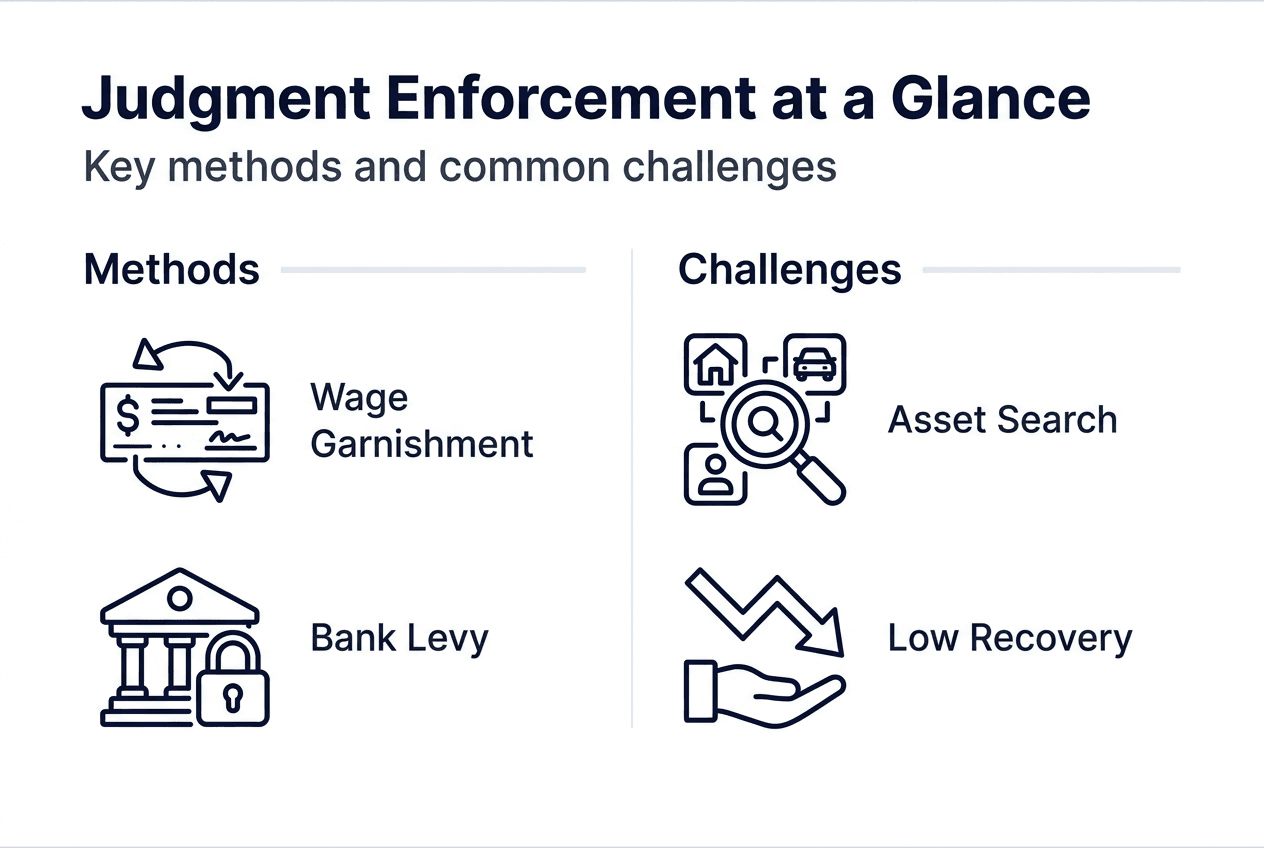
Wage garnishment directs the debtor's employer to withhold earnings and pay you directly. Federal law limits garnishment to 25% of disposable income or the amount exceeding 30 times the federal minimum wage, whichever is less. Some states impose stricter limits. Child support and federal student loans follow different rules with higher percentages allowed.
Judgment liens attach to the debtor's real property in the county where you file the lien. The debtor cannot sell or refinance without addressing your claim. Unlike property liens created by consent, judgment liens arise from court rulings and operate differently. They do not give you immediate possession but secure your interest.

Bank levies freeze and seize funds from the debtor's accounts. You must identify the specific bank and account and then obtain a writ directing the institution to turn over available funds. Certain funds remain exempt, including Social Security benefits and some retirement accounts.
Installment orders require the debtor to make regular payments over time. Courts may set payment schedules based on the debtor's income and expenses. This method works well when the debtor has a steady income but insufficient assets for immediate full payment.
The writ of execution authorizes seizure of non-exempt personal property. A sheriff or marshal physically takes possession of assets such as vehicles, equipment, or inventory. These items are sold at auction with proceeds applied to your judgment. Post-judgment seizure follows judicial authorization, ensuring due process protections.
Enforcement Methods Comparison:
| Method | Description | Advantages | Limitations | Best Use |
|---|---|---|---|---|
| Wage Garnishment | Employer withholds a percentage of earnings. | Steady income stream, predictable. | Limited to 25% federally, requires employment. | Debtor with a stable job. |
| Judgment Lien | Secures interest in real property. | Long duration; clouds title. | No immediate payment; debtor may not sell. | Debtor owns real estate. |
| Bank Levy | Freezes and seizes account funds. | Quick access to cash. | Must locate the account; exemptions apply. | Known bank accounts. |
| Writ of Execution | Sheriff seizes and sells property. | Tangible assets converted to cash. | Costs upfront; many exemptions. | Valuable non-exempt property. |
| Installment Order | Court-ordered payment plan. | Steady payments; court oversight. | Requires debtor cooperation. | Limited assets; steady income. |
Pro Tip: Investigate the debtor's assets before choosing an enforcement method. Order a judgment debtor examination where the debtor must answer questions under oath about income, accounts, and property. This discovery prevents wasting money on ineffective enforcement.
Navigating Judgment Liens, Collections, and Selling Judgments
Collecting on judgments presents significant challenges. Research indicates that 80% of civil judgments remain uncollected, often due to debtor insolvency, hidden assets, or legal obstacles. Understanding your options helps you make strategic decisions.
Judgment liens differ from property liens in fundamental ways. Property liens typically arise from voluntary transactions like mortgages or mechanic's liens filed after providing services. Judgment liens result from court orders issued after litigation. Property liens often grant specific rights to foreclose or force a sale. Judgment liens primarily cloud title and provide a security interest.
Direct collection requires persistence and incurs costs. You bear expenses for filing fees, service costs, and potentially attorney fees. Each enforcement method adds costs. Debtors may challenge garnishments, claim exemptions, or transfer assets beyond reach. Collection can stretch over years with uncertain outcomes.
Selling judgments transfers collection rights to specialized buyers for immediate cash. Buyers assume all collection risks and costs. Offers typically range from 10% to 50% of face value, depending on multiple factors. While you receive less than full value, you eliminate uncertainty and ongoing expenses.
Collecting vs. Selling Comparison:
| Factor | Self-Collection | Selling Judgment |
|---|---|---|
| Upfront Cost | High (filing, service, attorney fees). | None (buyer pays). |
| Time Commitment | Months to years. | Days to weeks. |
| Recovery Amount | Full value if successful. | 10%–50% of face value. |
| Risk | You bear all collection risk. | Buyer assumes all risk. |
| Control | You direct all enforcement. | Buyer controls the process. |
| Stress | Ongoing management required. | Single transaction. |
Factors Affecting Collection Success:
- The debtor's current employment and income stability.
- Real property ownership and equity position.
- Bank accounts and liquid assets.
- State exemption laws protect certain property.
- The age of the judgment and the remaining enforcement period.
- The debtor's willingness to cooperate or resist.
- Your budget for ongoing enforcement costs.
Pro Tip: Before deciding between collection and sale, obtain a current credit report and asset search on the debtor. If the debtor shows minimal assets, steady employment, or recent bankruptcies, selling to an agency often provides better net recovery than prolonged enforcement efforts.
State-Specific Considerations and Practical Tips for Judgment Enforcement
Enforcement rules vary dramatically by state. Each jurisdiction sets its own procedures, exemptions, and limits. Successful enforcement requires understanding your state’s specific requirements.
California follows the California Code of Civil Procedure for all judgment matters. The state allows wage garnishment of up to 25% of disposable income, with specific procedures for employer service. California judgments last for 10 years and can be renewed. The state provides extensive debtor protections, including homestead exemptions of up to $600,000.
North Dakota limits garnishment to 20% of disposable income, stricter than federal law. The state exempts homesteads of up to $100,000, household goods, and tools of trade. North Dakota judgments remain enforceable for 10 years. Corporations may enforce through authorized officers without attorney representation in some situations.
Exemptions protect certain debtor assets from seizure. Nearly all states exempt Social Security benefits, disability payments, and unemployment compensation. Homestead exemptions vary from zero in a few states to unlimited protection in others. Vehicle exemptions typically protect basic transportation. Understanding exemptions prevents wasted enforcement on protected assets.
Practical Enforcement Tips:
- File your judgment lien promptly in every county where the debtor owns property.
- Serve all enforcement documents according to state requirements or risk invalidation.
- Monitor expiration dates and renew judgments before they lapse.
- Document every enforcement attempt with dates, methods, and results.
- Consider professional skip tracing to locate hidden assets or current employment.
- Review updated debtor financial information annually, as circumstances change.
- Maintain copies of all court filings and proofs of service.
- Consult local enforcement strategies specific to your jurisdiction.
Patience and diligence matter. Effective enforcement rarely succeeds immediately. Debtors change jobs, acquire assets, and improve financial conditions over time. Maintaining your judgment and monitoring the debtor positions you to act when opportunities arise.
Common pitfalls derail many creditors. Missing filing deadlines can void your judgment or lien. Improper service allows debtors to challenge enforcement. Attempting to seize exempt property wastes money and may create liability. Violating garnishment limits or procedures can result in penalties. Careful attention to procedural requirements protects your rights.
Pro Tip: Many state-specific guides provide detailed enforcement procedures, forms, and timelines. Invest time in learning your jurisdiction’s specific requirements before starting enforcement. Local court clerks can often direct you to self-help resources and form packets.
Explore Solutions for Judgment Collection and Sales
After understanding judgment terminology and enforcement complexity, you may recognize the value of professional assistance. Great Lakes Strategic Capital specializes in helping individuals and small businesses navigate judgment recovery challenges.

Whether you choose to pursue collection or explore selling your judgment, having expert guidance simplifies the process. Our innovative tools, like LLMSTxt and the Judgment Dashboard, help you track, manage, and evaluate your judgment's potential. These resources provide clarity on collection probability and potential sale value.
Partnering with experienced professionals reduces your time commitment and eliminates uncertainty. Rather than spending months or years chasing debtors through complex enforcement procedures, you can convert your judgment into immediate financial value. We handle all aspects of evaluation, documentation, and transaction completion.
For those ready to move forward, explore our services to discover how we transform uncollected judgments into tangible results. Our nationwide reach and Michigan-based expertise ensure professional, compliant service tailored to your specific situation.
Frequently Asked Questions
What Is the Difference Between a Final and an Interlocutory Judgment?
Final judgments resolve all claims in a case and trigger appeal deadlines and enforcement rights. Interlocutory judgments address only preliminary issues while litigation continues. Understanding whether a ruling is final impacts your enforcement strategy and timeline. You typically cannot enforce interlocutory orders.
How Much Can an Employer Garnish from Wages for Judgment Enforcement?
Federal law limits garnishment to 25% of disposable earnings or the amount exceeding 30 times the federal minimum wage, whichever provides more protection. Some states impose stricter limits, such as North Dakota's 20% maximum. Child support and federal student loans allow higher garnishment percentages exceeding the standard limit.
What Factors Influence the Price When Selling a Judgment?
Prices typically range from 10% to 50% based on several factors. Debtor financial status, including employment and assets, significantly impacts value. The age of the judgment matters because older judgments approach expiration. State enforcement laws affect collection difficulty. Stronger debtor finances and favorable local laws command higher prices.
Can I Enforce a Judgment Without Hiring an Attorney?
Many states allow individuals and businesses to pursue enforcement without counsel. Corporations may enforce through authorized officers in some jurisdictions. However, complex procedures and state-specific requirements often make professional help valuable. Improper enforcement attempts can waste money or create liability. Consider consulting an attorney for significant judgments or complicated debtor situations.
Recommended
Weighing your options? Compare enforcing a judgment yourself versus selling it for cash.

Wayne S. Bisard
Wayne S. Bisard is the owner of Great Lakes Strategic Capital, a U.S. Marine Corps veteran with 31+ years of investigative experience, and President of the Michigan Council of Professional Investigators.
More about WayneSee what your judgment is worth — free evaluation
No upfront fees. No collection hassle. Get a cash offer instead of waiting years.


