
Judgment assignment process Michigan: get 90% cash fast
Learn the Michigan judgment assignment process to get 70-90% cash fast. Complete guide covers legal requirements, steps, mistakes, and alternatives for 2026.
Great Lakes Strategic Capital
Great Lakes Strategic Capital

You have secured a judgment in Michigan; however, months have passed without any recovery. Every interaction with the debtor is fraught with delay tactics, evasions, or outright silence. The judgment assignment process offers a swift and legally sound avenue to transform that court ruling into immediate cash, often within 30 to 60 days. This guide outlines the necessary requirements, the step-by-step process, potential pitfalls, financial implications, and alternative collection strategies to empower you to make informed decisions and receive your payment promptly.
Table of Contents
- Prerequisites and Legal Framework
- Judgment Assignment Process Step-by-Step
- Common Mistakes and Troubleshooting
- Expected Outcomes and Financial Considerations
- Alternative Approaches and Tradeoffs
- Get Cash Today with Great Lakes Strategic Capital
- Frequently Asked Questions
Key Takeaways
| Point | Details |
|---|---|
| Enforceability Period | Michigan judgments are valid for 10 years, with an option to renew for an additional 10 years. |
| Assignment Value | Creditors can typically expect to receive 70% to 90% of the judgment's principal amount upfront. |
| Process Timeline | The assignment process usually requires 30 to 60 days and necessitates court approval. |
| Common Errors | Not verifying judgment enforceability or missing renewal deadlines can significantly reduce your potential recovery. |
| Alternative Methods | Pursuing garnishment or installment plans may take longer and involve more effort, offering less upfront liquidity. |
Prerequisites and Legal Framework
Before moving forward with assigning your judgment, it is crucial to ensure that it adheres to Michigan's legal requirements. Only final, non-consumer civil judgments where the appeal period has lapsed are eligible for assignment. Michigan law permits civil judgments to be enforced for up to 10 years, with a renewal option for another decade through a formal motion to the court. This extended timeframe grants you leverage to pursue collection or assignment, provided you act promptly and within legal confines.
It is vital that there are no active bankruptcy stays or enforcement stays affecting your judgment. When a debtor files for bankruptcy, an automatic stay halts all collection efforts, including assignment. Similarly, if a court has issued an enforcement stay, your collection rights are paused until that stay is lifted. You will need to furnish certified copies of your judgment along with evidence that no pending appeals obstruct enforcement. Purchasers and courts require these documents to validate your judgment's authenticity and confirm your authority to transfer it.
Awareness of these prerequisites is crucial to avoid unnecessary delays and potential legal disputes. Neglecting verification steps could jeopardize the sale or lead to complications after the assignment is finalized. The judgment assignment process overview outlines the criteria that purchasers seek in eligible judgments. Understanding Michigan’s renewal requirements ensures your judgment remains enforceable throughout the assignment process.
Key prerequisites to consider include:
- Your judgment must be a final judgment that has passed the appeal period.
- Ensure that no active bankruptcy or enforcement stays affect your judgment.
- Obtain certified copies of the judgment and any relevant appeal documentation.
- Verify that the judgment remains enforceable within the 10-year window.
- Confirm that the judgment is classified as a non-consumer civil judgment.
Judgment Assignment Process Step-by-Step
The assignment process unfolds in a defined sequence that ensures protection for both the creditor and the purchaser. Begin by confirming that your judgment is final, enforceable, and unencumbered by any appeals or stays. Gather certified copies of your judgment and relevant appeal documentation from the court clerks; these documents substantiate the judgment's validity and your legal capacity to assign it.
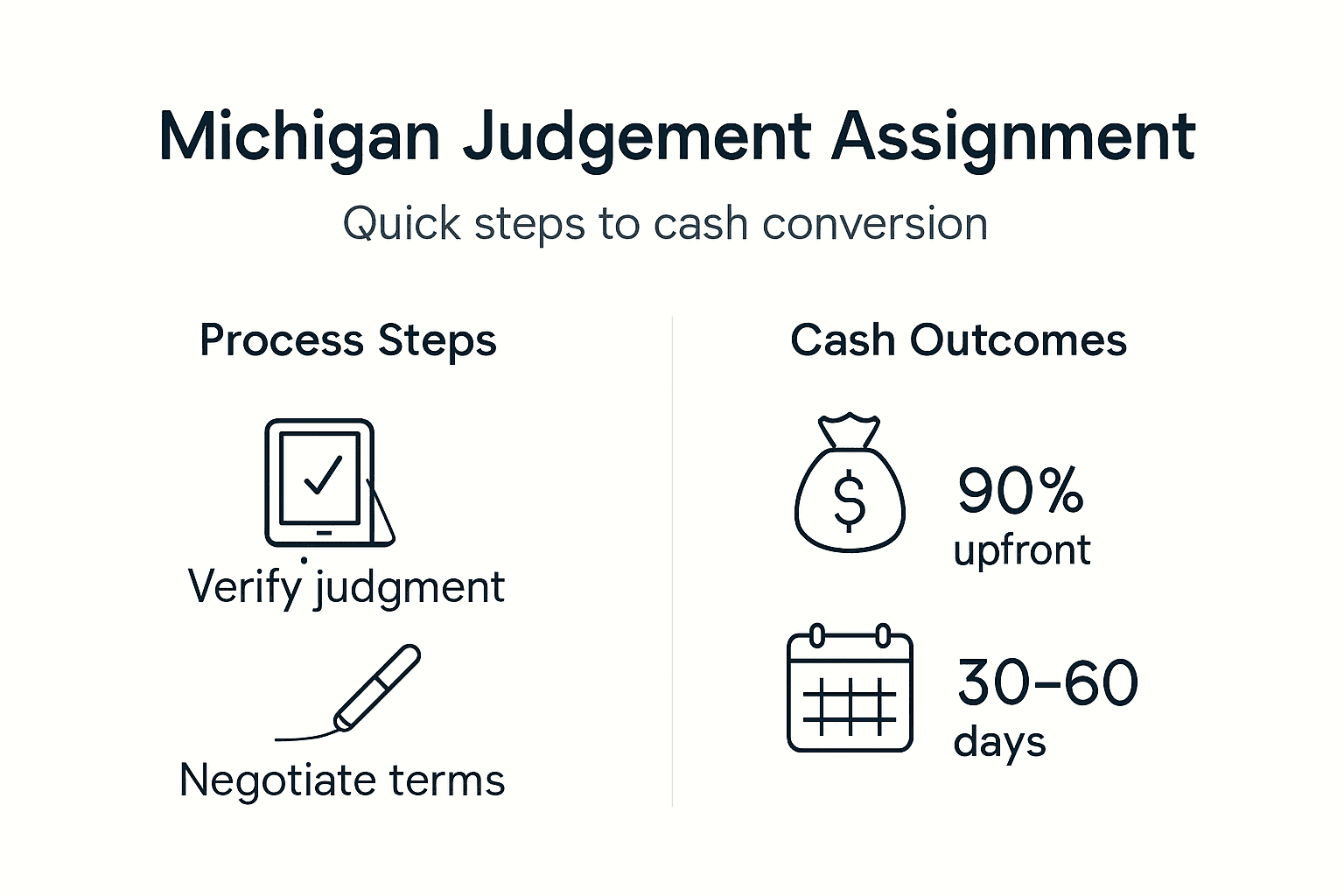
Next, negotiate assignment terms with a licensed purchaser, focusing on pricing and timing. Licensed purchasers acquire judgments via assignment, providing immediate cash to creditors while assuming the risks associated with collection. Anticipate receiving offers that range from 70% to 90% of the judgment's principal, influenced by the debtor's financial situation, the age of the judgment, and its collectibility. After agreeing on terms, both parties should sign a written settlement agreement, as Michigan law mandates that this agreement be documented and court-approved to be enforceable.
Following the signing, submit the settlement agreement to the court for approval. The court will evaluate the agreement to ensure compliance with state laws and protection for all parties involved. Once approved, you can expect the upfront cash payment shortly after, typically within days. The purchaser will then take over all responsibilities associated with collection.
Here is a detailed breakdown of the assignment steps:
- Confirm the finality and enforceability of your judgment.
- Gather certified copies of the judgment and relevant appeal documentation.
- Negotiate assignment terms with a licensed judgment purchaser.
- Execute a written settlement agreement, ensuring both parties sign it.
- Submit the agreement to the court for formal approval.
- Receive the upfront cash payment after court approval.
Pro Tip: Enhance your negotiation leverage by thoroughly reviewing the judgment assignment steps and familiarizing yourself with Michigan judgment collection insights prior to discussions. This preparation can help you identify fair offers and facilitate better terms.
For further legal insights, consider consulting the judgment purchaser overview and the Michigan judgment assignment statute to fully grasp your rights and responsibilities.
Common Mistakes and Troubleshooting
Many creditors face setbacks and financial losses due to oversight of critical details. Avoid assigning judgments without first confirming their finality and the absence of stays or appeals. A judgment under appeal cannot be assigned, wasting both your time and resources. Additionally, keep a close watch on renewal deadlines to protect your enforcement rights. If your judgment approaches its 10-year expiration, file a renewal motion to maintain your rights without delay.
To avert court or purchaser-related delays, provide comprehensive and certified documentation. Incomplete submissions often result in requests for additional paperwork, which can postpone your payment timeline. It is crucial to grasp the implications of the assignment; once you have assigned the judgment, the purchaser assumes ownership and control over collection actions. You can no longer alter the assignment or regain rights to the judgment.
Consider seeking legal assistance when faced with uncertainties to protect your interests. Errors such as neglecting to verify enforceability or missing renewal deadlines can lead to lost rights or diminished payments. Consulting with an attorney can prevent the unnecessary loss of value amounting to thousands of dollars.
Common mistakes to avoid include:
- Assigning judgments affected by pending appeals or legal stays.
- Failing to meet 10-year renewal deadlines, jeopardizing enforceability.
- Providing incomplete or uncertified documentation.
- Not understanding the permanence of the assignment process.
- Bypassing legal review when the procedure is unclear.
Pro Tip: Set a reminder for yourself 90 days prior to your judgment's 10-year anniversary to initiate the renewal process. Courts require time to process these motions, and early filing is essential to avoid last-minute complications. For guidance, explore common judgment assignment mistakes and review typical errors in judgment collection throughout Michigan.
Expected Outcomes and Financial Considerations
The assignment process typically spans 30 to 60 days, contingent upon court schedules and the completeness of documentation. During this timeframe, creditors can expect to receive between 70% and 90% of their judgment amount upfront. This immediate liquidity starkly contrasts with traditional collection methods that can drag on for months or even years.
While methods like garnishment or property liens require relentless efforts, legal fees, and depend on the debtor's cooperation, assignment shifts the obligations and risks from the creditor to the purchaser. This alleviates potential collection headaches.

This choice prioritizes quick cash recovery, even if it means opting for a partial discount on the full judgment amount. If immediate funds are essential or if collection resources are limited, assignment serves as a suitable route. Conversely, if you have the capacity to wait and the debtor possesses stable income or assets, pursuing traditional avenues may yield more substantial returns over time.
| Outcome Factor | Typical Result |
|---|---|
| Process Duration | 30 to 60 days |
| Upfront Payment | 70% to 90% of principal |
| Risk Transfer | The purchaser absorbs all risk associated with collection |
| Future Involvement | No further responsibilities after assignment |
| Liquidity | Immediate cash influx |
For insights into the financial benefits of judgment assignment, explore our analysis of the financial aspects and review the timelines for judgment collection in Michigan to gauge assignment speed against traditional recovery methods.
Alternative Approaches and Tradeoffs
While judgment assignment is a valuable strategy, it is not the sole collection method available. Garnishment allows you to claim up to 25% of a debtor's wages, but this process can lead to fragmented and slower recovery, as payments are doled out monthly and hinge on the debtor remaining employed. If the debtor changes jobs or relocates, garnishment efforts may stall until they can be tracked down again.
As for installment payment plans, they require ongoing management from the creditor to ensure timely payments. This involves tracking, sending reminders, and potentially returning to court in case of default. Such traditional enforcement strategies can consume months or years, resulting in increased costs in legal fees and administrative tasks. Each garnishment or lien entails additional court filings and sometimes necessitates legal representation.
Ultimately, judgment assignment emphasizes immediacy and certainty over maximum recoveries, making it an ideal choice for creditors seeking liquidity. In contrast, methods like garnishment might offer full payment potential but come with longer timelines, increased costs, and unpredictable results. If your financial situation demands swift action or you seek to eliminate collection hassles, assignment is the optimal solution.
| Method | Speed | Recovery Rate | Creditor Effort | Risk |
|---|---|---|---|---|
| Assignment | 30-60 days | 70-90% upfront | Minimal | Transferred to purchaser |
| Garnishment | Months to years | Up to 100% over time | High | Creditor retains risk |
| Installment Plan | Months to years | Up to 100% over time | Moderate | Creditor retains risk |
| Property Lien | Months to years | Up to 100% upon sale | Moderate | Creditor retains risk |
Key trade-offs to consider include:
- Assignment secures immediate cash at a lower amount than the full judgment.
- Garnishment demands consistent monitoring and can result in costly legal efforts.
- Installment plans rely heavily on debtor compliance.
- Property liens yield payment only when a sale or refinance occurs.
- Traditional methods offer higher full recovery but introduce longer timelines and increased costs.
For a more detailed examination of enforcement options, visit judgment enforcement options, read about enforcement trade-offs, and understand how to sell your judgment quickly. For a comprehensive comparison of methods, refer to our judgment collection comparison.
Get Cash Today with Great Lakes Strategic Capital
Now that you are familiar with the judgment assignment process, the common pitfalls, and the financial ramifications involved, you can take action. Great Lakes Strategic Capital specializes in transforming your Michigan judgments into immediate cash. Our service is designed to be transparent, legally compliant, and poised to maximize your recovery efficiently.

Visit our sell your judgment page to begin the process of converting your non-consumer civil judgment into cash today. Discover how the judgment assignment process operates by reviewing our streamlined procedure. Stay updated with the latest tips and industry insights through our judgment assignment insights blog. Our dedicated team manages all necessary court filings, documentation, and legal compliance, allowing you to concentrate on what matters most.
Frequently Asked Questions
What makes a Michigan judgment eligible for assignment?
A judgment is eligible for assignment if it is a final, non-consumer civil judgment where the appeal period has expired, and no active bankruptcy or enforcement stays hinder collection. It should also be within or renewed for the 10-year enforceability period.
How long does the judgment assignment process take in Michigan?
Typically, the entire process lasts 30 to 60 days, from the initial agreement to the receipt of cash. Variability occurs based on county-specific court approval timelines, but complete documentation generally ensures adherence to this timeframe.
What rights do I retain after assigning my judgment?
Post-assignment, you forfeit all rights to the judgment. The purchaser assumes complete ownership and collection responsibilities. Reversing the assignment or reclaiming the judgment is not an option.
Is court approval required for judgment assignment in Michigan?
Yes, the law mandates court approval of the settlement agreement to formalize the assignment, ensuring compliance with state law and safeguarding all parties' interests.
What happens if my judgment is near the 10-year expiration?
Immediately file a renewal motion to extend the enforceability period for another 10 years. Most purchasers are reluctant to buy a judgment close to expiration unless a renewal motion is already pending or approved. Familiarize yourself with the judgment assignment process and renewal requirements to protect your rights.
Recommended
Weighing your options in Michigan? Compare enforcing a judgment yourself versus selling it for cash, or read our full Michigan judgment recovery guide.

Wayne S. Bisard
Wayne S. Bisard is the owner of Great Lakes Strategic Capital, a U.S. Marine Corps veteran with 31+ years of investigative experience, and President of the Michigan Council of Professional Investigators.
More about WayneSee what your Michigan judgment is worth — free evaluation
No upfront fees. No collection hassle. Get a cash offer instead of waiting years.


